

TL;DR:
- Seasonal travel photography in Japan requires deliberate timing to capture unique atmospheric transformations.
- Planning around peak bloom and foliage windows involves research, forecasting, and flexible scheduling.
- Techniques like golden hour shooting, weather adaptation, and cultural awareness enhance seasonal images.
Most amateur photographers believe that a great travel photo is mostly about being in the right place. But the real secret is being there at the right time. Seasonal changes transform Japan’s most iconic locations more dramatically than any filter or editing trick ever could. The soft pink haze of cherry blossoms over Kyoto’s Maruyama Park, the fiery maple canopy above Nara’s ancient paths, the misty silence of Tokyo’s Shinjuku Gyoen in early winter — these are not just scenes. They are seasonal visual characteristics shaped by light, color, and atmosphere that only appear in specific windows of time. This guide gives you practical frameworks, planning tools, and concrete examples to help you capture Japan’s seasons with intention.
Table of Contents
- What is seasonal travel photography?
- How to plan and prepare for Japan’s seasonal scenes
- Techniques for capturing each season’s essence
- Mistakes to avoid and expert insights
- Success metrics: What makes a great seasonal travel photo?
- Why following the crowd isn’t enough — How to develop your seasonal vision
- Ready to transform your seasonal photography journey?
- Frequently asked questions
Key Takeaways
| Point | Details |
|---|---|
| Plan for peak season | Timing your trip around seasonal events like cherry blossoms or fall foliage maximizes visual impact and creative opportunity. |
| Adapt your technique | Leverage changing light, color, and local weather for images that go beyond tourist snapshots. |
| Embrace unpredictability | Being flexible and responsive gives you access to truly unique moments, even when nature changes plans. |
| Prioritize original storytelling | Focus on unique compositions, emotion, and atmosphere to set your work apart from generic images. |
What is seasonal travel photography?
Seasonal travel photography is not simply taking pictures while you travel. It is a deliberate practice of planning your trips around the visual and atmospheric transformations that each season brings to a specific location. This is what separates it from general travel photography, which tends to treat destinations as static backdrops.
General travel photography captures a place. Seasonal travel photography captures a moment in that place’s year. The difference matters enormously for the quality and originality of your images.
Seasonal photography focuses on how light, color, and nature transform famous destinations at specific times of year, and it requires planning around seasonal peak events and conditions. That means researching bloom windows, foliage peaks, festival dates, and even the angle of winter sunlight before you book a single flight.
Here is a quick comparison to clarify the distinction:
| Feature | General travel photography | Seasonal travel photography |
|---|---|---|
| Planning focus | Destination | Destination + timing |
| Subject | Landmarks, people, culture | Nature, light, seasonal mood |
| Flexibility | High | Moderate (peak windows matter) |
| Skill emphasis | Composition, exposure | All of the above + forecasting |
| Repeatability | High | Low (each season is unique) |
The essential qualities that define seasonal travel photography include:
- Intentional timing: Arriving during a specific seasonal window, not just when flights are cheap
- Mood awareness: Reading the atmosphere and adjusting your shooting style accordingly
- Color sensitivity: Understanding how seasonal palettes shift and how your camera captures them
- Cultural context: In Japan especially, seasons carry deep meaning tied to festivals, food, and daily life
“The seasons are not just backgrounds. They are the story itself. A photograph taken in peak autumn Kyoto and one taken in summer tells two entirely different stories about the same place.” This is the mindset that separates memorable images from forgettable ones.
If you want to improve travel photography approaches, understanding the seasonal dimension is one of the highest-leverage shifts you can make as an amateur.
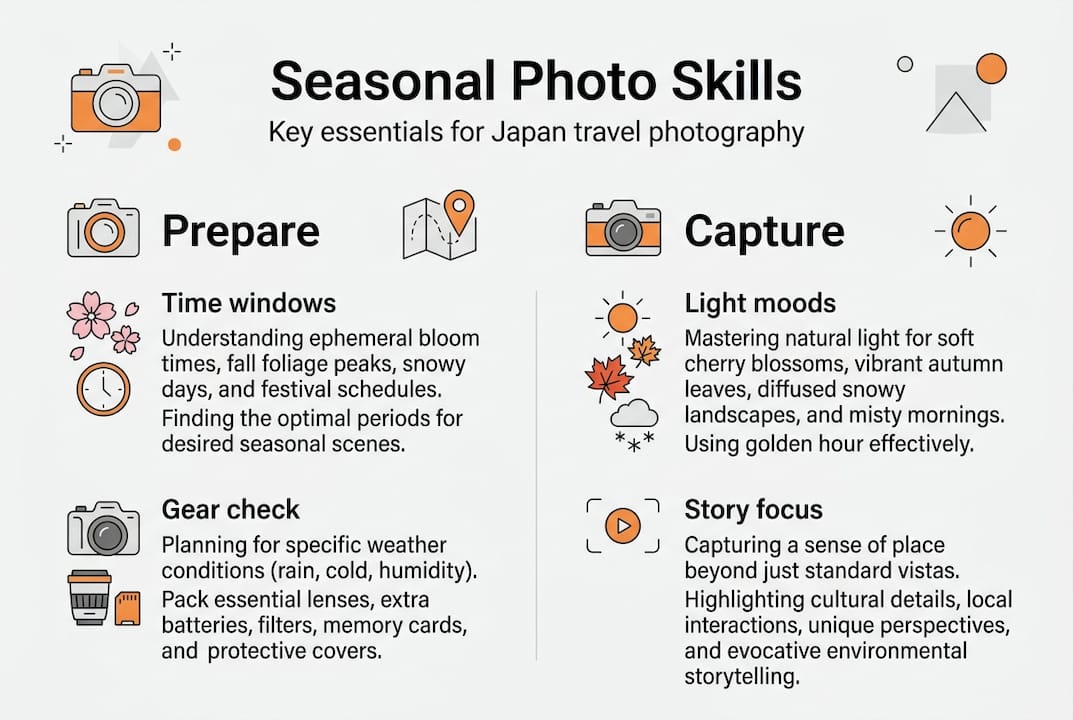
How to plan and prepare for Japan’s seasonal scenes
Knowing what seasonal travel photography is, the next step is learning how to actually select, research, and plan for Japan’s world-famous seasonal transitions.
Japan’s seasons are famously precise, and the windows for peak color or bloom can be surprisingly short. Peak cherry blossom timing in Tokyo falls in late March to early April, while Kyoto’s sakura peaks slightly earlier in mid to late March. Kyoto’s autumn foliage typically reaches its height between November 15 and December 5, though weather shifts and elevation can move these windows by several days in either direction.
Here is a practical reference table for planning your trip:
| Location | Season | Optimal window | Key subject |
|---|---|---|---|
| Tokyo (Shinjuku Gyoen) | Spring | Late March to early April | Cherry blossoms |
| Kyoto (Arashiyama) | Autumn | Nov 15 to Dec 5 | Maple foliage |
| Nara (Yoshino) | Spring | Early to mid April | Mountain sakura |
| Kamakura | Autumn | Mid to late November | Temple foliage |
| Osaka (Osaka Castle) | Spring | Late March to early April | Cherry blossoms |
For planning, follow these steps:
- Set your target season and location at least three to four months in advance, since popular spots in Kyoto and Tokyo fill up fast
- Monitor forecasting apps like Weathernews Japan or the Japan Meteorological Corporation’s bloom forecasts for real-time updates
- Check the Tokyo sakura forecast closer to your travel dates, as predictions sharpen within two weeks of peak
- Research local rules before you go, including which temples restrict tripods and which parks require permits for commercial shooting
- Book accommodations near your target spots so you can respond quickly to early morning light or sudden weather changes
For photography trips timing in Japan, flexibility is your most valuable asset. Build at least two buffer days into your schedule to account for weather shifts or early peaks.
Pro Tip: Do not lock every day of your itinerary. Japan’s seasons do not follow a strict calendar, and the best light often appears on a morning you did not plan for. A loose schedule lets you chase the moment instead of your agenda. For deeper location-specific guidance, the Kyoto city photo guide is a strong starting point.
Techniques for capturing each season’s essence
Once you have your dates and locations, you need the right shooting know-how to translate seasonal atmosphere into memorable images.
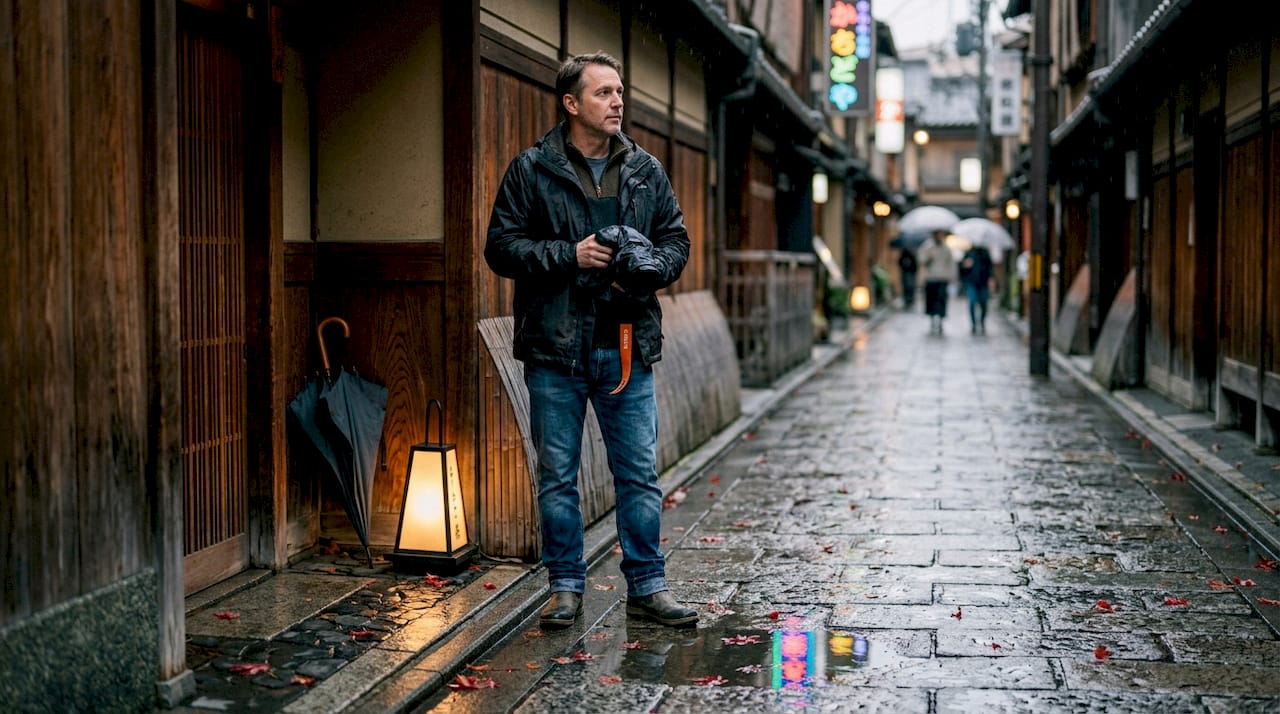
The technical foundation of great seasonal photography comes down to a handful of core methods. Golden and blue hour timing, polarizing filters, shooting in RAW format for post-processing flexibility, embracing variable weather for mood, advanced composition thinking, and the right lens and tripod choices all work together to elevate your results.
Here is how to apply these techniques across Japan’s main seasons:
- Spring (sakura season): Shoot during the first hour after sunrise to avoid crowds and catch soft, diffused light. A 70-200mm telephoto lens helps isolate individual blossoms against a blurred background. Overcast days are your friend — flat light makes pink tones glow without harsh shadows.
- Summer: Japan’s summer brings dramatic skies and vivid greens. Use a polarizing filter to deepen blue skies and cut reflections on water surfaces. Festivals like Tanabata Matsuri offer rich cultural color, so a 35mm or 50mm prime lens works well for street scenes.
- Autumn: This is arguably the most rewarding season for color. A wide-angle lens captures the full sweep of maple canopies, while a telephoto compresses layers of red and gold for abstract compositions. Shoot RAW to preserve the full range of warm tones in post-processing.
- Winter: Low contrast and muted tones define Japan’s winter light. Look for reflections in wet stone paths after rain, or the graphic simplicity of bare branches against a gray sky. A tripod is essential for long exposures in low light.
Pro Tip: Do not pack up when it starts raining. Rain creates reflections, mist, and a moody atmosphere that completely transforms a scene. Some of the most striking seasonal images come from photographers who stayed out while everyone else ran for cover. For more on landscape techniques for Japan, and how to use lighting tips for Japanese seasonality, those resources go deeper into the technical side. Strong composition ideas for Japan can also help you move beyond the obvious framing.
Mistakes to avoid and expert insights
Even the best-planned shoots can go sideways, so it pays to know where most enthusiasts trip up and what the experts do differently.
Here are the most common mistakes amateur photographers make during Japan’s seasonal peaks:
- Overediting colors: Autumn foliage in Japan is already vivid. Pushing saturation sliders too far creates images that look artificial and lose the subtle warmth that makes Japanese maples so beautiful.
- Ignoring local rules: Tripods are restricted in many of Kyoto’s most popular temples, and tourism peaks bring heavy crowds that can make traditional compositions nearly impossible.
- Trusting forecasts too rigidly: Weather swings can shift peak color by several days. Photographers who arrive expecting a specific date and refuse to adapt often miss the actual peak entirely.
- Shooting only the obvious spots: Every photographer at Kinkaku-ji during peak autumn is shooting the same angle. Walking five minutes off the main path often reveals compositions no one else is capturing.
- Neglecting the edges of the season: The day before full bloom and the day after peak color both offer unique, less-crowded opportunities with their own visual character.
“The photographers who come home with the most original work are rarely the ones who followed the forecast perfectly. They are the ones who stayed curious when conditions changed.” This is the mindset that turns a missed peak into a creative breakthrough.
For practical guidance on dealing with Japan’s weather as a variable rather than an obstacle, that resource covers specific strategies for each season. Reviewing fall photography best practices can also give you a broader framework for working with autumn light and color.
Success metrics: What makes a great seasonal travel photo?
After learning what to avoid, it is vital to know how to actually gauge your growth and the unique value of your seasonal images.
Photography success is measured by unique compositions and personal perspective over generic snapshots. Crowd hotspots naturally generate repetitive subject matter, but critical thinking and flexible intent are what produce images worth keeping.
Use this checklist to evaluate your seasonal images:
- Original viewpoint: Does your image show the scene from an angle most visitors would not think to use?
- Emotional resonance: Does the photo convey a feeling, not just a fact about the location?
- Seasonal specificity: Would this image only be possible during this exact season? If it could have been taken in any month, the seasonal element is not doing enough work.
- Cultural context: Does the image include a detail, a person, or a cultural element that roots it in Japan’s living traditions?
- Technical quality: Is the exposure, focus, and composition strong enough to support the story you are trying to tell?
Here is a simple framework for self-critique after each shoot:
| Question | What to look for | How to improve |
|---|---|---|
| Is the composition original? | Avoid symmetrical, centered tourist shots | Experiment with foreground elements |
| Does the light serve the mood? | Flat midday light rarely adds drama | Prioritize golden and blue hour |
| Is the seasonal element central? | Blossoms or foliage should anchor the frame | Recompose to feature seasonal color |
| Does it tell a story? | Static scenes without context feel empty | Include human or cultural elements |
Reviewing your images with these questions after every trip builds a habit of intentional critique. Over time, this is how you develop a personal style rather than just a collection of travel snapshots. Exploring personal growth via Japan photo tours is one way to accelerate that process with structured feedback.
Why following the crowd isn’t enough — How to develop your seasonal vision
At this point, you might be asking: how can you set your photography apart from the crowds lining up for the same seasonal scenes?
Here is an uncomfortable truth. The most iconic seasonal spots in Japan, Maruyama Park in spring, Tofuku-ji in autumn, are iconic precisely because they are beautiful. But beauty alone does not make a photograph memorable. What makes it memorable is your interpretation of that beauty.
The photographers who build genuinely compelling portfolios from Japan’s seasons are the ones who treat an off-peak morning, an overcast sky, or a late bloom not as failures but as invitations to experiment. A half-fallen cherry blossom on wet pavement tells a richer story than a perfectly framed canopy shot taken by a thousand people before you.
Storytelling through mood, atmosphere, and cultural context is what elevates seasonal work. A monk walking through autumn leaves, a child reaching for a low-hanging blossom, a lantern reflected in a rain-soaked stone path — these details carry emotional weight that pure landscape shots rarely achieve. For ideas on how to push your creative thinking, cityscape experimentation ideas offers a useful starting point for thinking beyond the obvious frame.
Ready to transform your seasonal photography journey?
Understanding seasonal travel photography is one thing. Practicing it in Japan’s most visually rich cities, with expert guidance and a group of like-minded photographers, is something else entirely.

Our Japan photo tours are designed specifically for American amateur photographers who want to move beyond tourist snapshots and develop real skills in real locations. You will shoot alongside experienced guides who know exactly where to stand, when to arrive, and how to adapt when conditions change. If you are ready to see what intentional seasonal photography feels like in practice, unlock creative growth with a trip built around Japan’s most extraordinary seasonal windows.
Frequently asked questions
What gear is essential for seasonal travel photography in Japan?
A DSLR or mirrorless camera, a mix of wide and telephoto lenses, a tripod where permitted, extra batteries, and a weather-sealed bag are all recommended for Japan’s changing seasonal conditions. Having the right equipment ready means you can respond quickly when the light shifts.
When is the best time to visit Japan for cherry blossom and autumn foliage photography?
Tokyo sakura peaks in late March to early April, while Kyoto’s autumn colors typically reach their height from mid-November to early December. These windows can shift by several days depending on annual weather patterns.
What mistakes should beginners avoid when photographing Japan’s seasons?
Avoid overediting colors, ignoring local etiquette like tripod restrictions in temples, and relying too heavily on forecasted peak dates since weather can shift the ideal timing unexpectedly.
Can I use a smartphone for seasonal travel photography?
Smartphones work well for quick, casual shots, but a dedicated camera gives you far greater creative control, especially in the challenging seasonal light conditions Japan regularly presents.
How do I avoid crowds during Japan’s seasonal peaks?
Arrive early in the morning, visit on weekdays when possible, and explore less-known spots away from the main tourist paths. Building flexibility into your schedule gives you the best chance of finding quieter, more original compositions.
